The phrase text to text meaning is something many people search when they want to understand how words or messages are interpreted between written conversations.
It often refers to how one piece of text connects to another, how a message is translated into a different form, or how meaning is understood in digital communication.
With the rise of messaging apps, online learning, and AI tools, people want quick clarity about what “text to text” really means.
Sometimes the phrase appears in school assignments, sometimes in technology discussions, and sometimes in casual chats.
That can make it confusing.
This guide explains the term in simple language.
You will learn what it means, where it comes from, how people use it, and how to respond when someone mentions it.
By the end, you will feel confident using and understanding it in daily life.
What Does Text to Text Mean in Text & Chat?
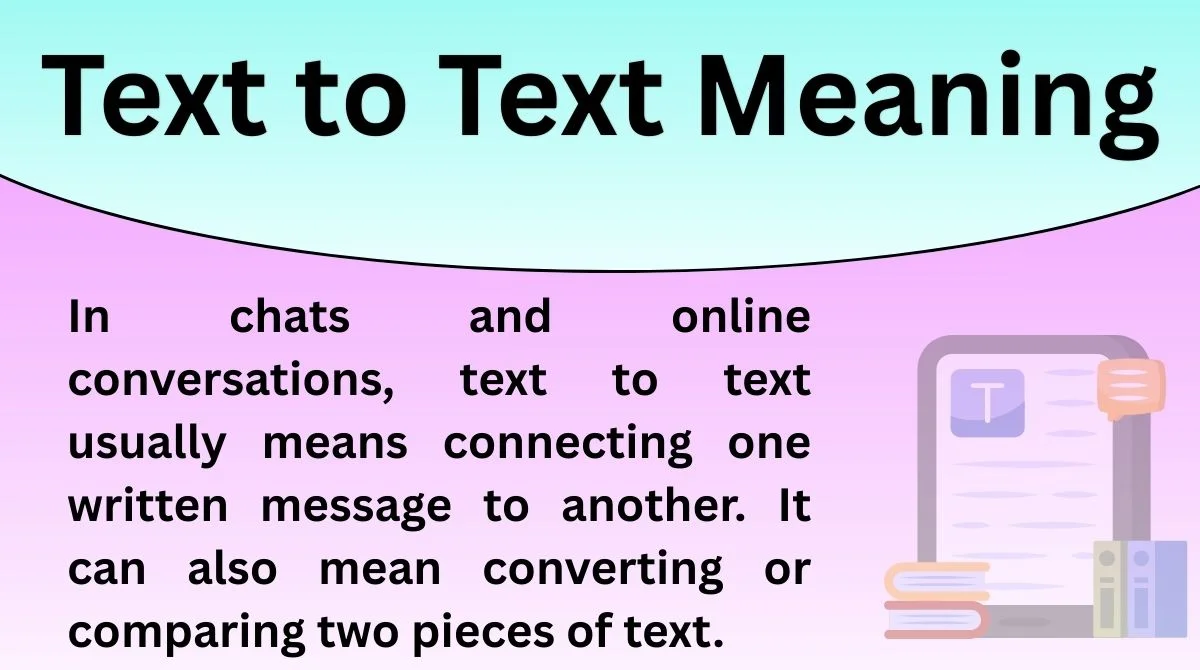
In chats and online conversations, text to text usually means connecting one written message to another. It can also mean converting or comparing two pieces of text.
For example, in school discussions, “text to text” means linking one story, article, or quote to another. In technology, it can mean transforming written input into another written output, like translation or paraphrasing.
In casual chat, someone might use it to describe:
- Comparing messages
- Copying information from one message to another
- Translating or rewriting text
- Connecting ideas between two posts
Quick examples:
- “This article has a text-to-text connection with the book we read.”
- “I used an app for text-to-text translation.”
- “Send it text to text so I can compare.”
The meaning depends on context. If the conversation is about school, it likely refers to connections between writings. If the topic is technology, it may refer to processing or converting text.
The key idea is simple: text interacting with another text.
Full Form, Stands For & Short Meaning of Text to Text
“Text to text” is not an abbreviation, so it does not have a full form like common internet slang. Instead, it is a descriptive phrase.
Short meaning:
Text to text = a relationship, comparison, or transformation between two written pieces.
People often use it in three main ways:
- Educational meaning – Connecting one reading to another.
- Technology meaning – Converting written input into new written output.
- Communication meaning – Comparing or sharing messages.
Simple explanation:
- Text → original message
- Text → new or related message
- Text to text → connection between them
Because the phrase is literal, its meaning stays easy to understand once you know the context.
Origin, History & First Known Use of Text to Text
The phrase became popular mainly in education. Teachers used “text-to-text connections” to help students compare stories, articles, and ideas. It helped improve reading skills and understanding.
Later, technology expanded the meaning. With digital tools, people began using the phrase for:
- Machine translation
- Paraphrasing tools
- AI writing systems
- Data processing systems
As smartphones and messaging apps grew, the phrase started appearing in casual language too. People used it informally to mean sending written content directly or comparing messages.
So the timeline looks like this:
- Education → reading comparisons
- Technology → text processing
- Social use → everyday communication
Today, the phrase has multiple meanings depending on the situation.
How People Use Text to Text in Daily Conversations
In everyday talk, people use “text to text” in relaxed ways. It is not strict or technical unless the topic requires it.
Common daily uses:
- Sharing notes between friends
- Comparing screenshots or messages
- Talking about homework
- Discussing translations
- Explaining AI tools
Examples in conversation:
- “Can you send it text to text? I don’t want a voice note.”
- “There’s a text-to-text connection between these two movies.”
- “This tool converts speech to text and text to text.”
People often shorten the phrase or use it casually without thinking about the exact meaning. Context tells you what they mean.
Text to Text Meaning Across WhatsApp, Instagram, TikTok & Snapchat
On social media platforms, the phrase can appear in captions, comments, or messages. The meaning often depends on the topic of discussion.
On messaging apps:
- WhatsApp: Sharing written info directly
- Instagram: Comparing captions or quotes
- TikTok: Talking about AI tools or educational content
- Snapchat: Sending written messages instead of voice
Examples:
- “Send text to text pls 🙏”
- “This scene has a text-to-text reference to another movie 🎬”
- “AI text-to-text tools are mistaken😳”
In most cases, it simply means written content interacting with other written content.
Different Meanings of Text to Text in Other Fields
The phrase appears in several areas, each with a slightly different meaning.
Education:
- Comparing literature
- Finding similarities between texts
Technology:
- Machine learning text transformation
- Language translation systems
- AI writing tools
Linguistics:
- Intertextual relationships between documents
Communication:
- Sending written messages only
Even though meanings vary, the core idea remains the same: one text connected to another.
Common Confusions, Mistakes & Wrong Interpretations
Many people misunderstand the phrase because it sounds technical.
Common mistakes:
- Thinking it is slang
- Assuming it is an abbreviation
- Confusing it with speech-to-text
- Believing it only applies to AI
Important differences:
- Speech to text = voice → writing
- Text to speech = writing → voice
- Text to text = writing → writing
Knowing this difference removes confusion.
Similar Terms, Alternatives & Related Slang
Some phrases have similar meanings depending on context.
Related terms:
- Intertextual connection
- Text comparison
- Paraphrasing
- Translation
- Copy text
- Rewrite text
Examples of Text to Text in Real Chat Situations
Here are simple real-life chat examples:
- “Can you send the notes text to text? 😊”
- “This poem has a text-to-text link with another one.”
- “I used AI for text-to-text translation.”
- “Don’t send audio, send text to text please.”
- “There’s a text-to-text reference in this meme 😂”
Quick bullet examples:
- Homework discussion
- Sharing information
- Comparing quotes
- AI tool usage
- Translation requests
How to Reply When Someone Says Text to Text
Your reply depends on context.
If they want written info:
- “Sure, I’ll send it.”
- “Here’s the text version.”
- “Okay, no voice notes.”
If they mean comparison:
- “Yes, I see the connection.”
- “Good point!”
If they mean technology:
- “Which tool are you using?”
- “That sounds useful.”
Always check context before replying.
Is Text to Text Still Popular? Trends & Online Usage
Yes, the phrase is becoming more common because of AI and digital learning. As more people use writing tools, translation apps, and messaging platforms, the term appears more often.
Reasons for growing popularity:
- AI tools
- Online education
- Remote work
- Social media content
- Digital communication habits
While it may not be trendy slang, it remains useful and relevant.
FAQs
1. What does text to text mean in simple words?
It means connecting or converting one written message into another written form.
2. Is text to text an abbreviation?
No. It is a descriptive phrase, not a shortened word.
3. What is text-to-text connection in school?
It means linking ideas between two readings or texts.
4. Is text to text related to AI?
Yes, in technology it refers to systems that transform written input into new written output.
5. What is the difference between text to text and speech to text?
Speech to text converts voice into writing. Text to text converts writing into new writing.
6. Why do people say send text to text?
They usually mean they want written information instead of voice notes or images.
Conclusion
The phrase text to text meaning may sound confusing at first, but it is actually simple.
It refers to the relationship, comparison, or transformation between two pieces of written content.
The meaning changes slightly depending on whether you are talking about school, technology, or daily communication.
However, the core idea always stays the same: one text connected to another text.
As digital communication continues to grow, this phrase will likely remain relevant.
Understanding it helps you in education, online conversations, and even when using modern AI tools.
Now that you know the meaning, you can confidently recognize and use it in different situations without confusion.

Freya Martin is a creative writer who loves playful wordplay, light humor, and engaging content for a global audience.