If you spend time online, you’ve likely seen “OP” in messages, comments, or captions.
Many people search for the OP meaning in text because it can change depending on context.
Sometimes it refers to a person in a conversation, while other times it describes something powerful or impressive.
That can be confusing, especially for new internet users or parents trying to understand slang.
The good news is that OP is simple once you know the basics.
It’s a short abbreviation with a few common meanings that appear across social media, gaming, and everyday chats.
In this guide, you’ll learn what OP means, where it came from, how people use it today, and how to reply when someone sends it to you.
The explanations are clear, friendly, and easy to follow—no complicated language needed.
What Does OP Mean in Text & Chat?
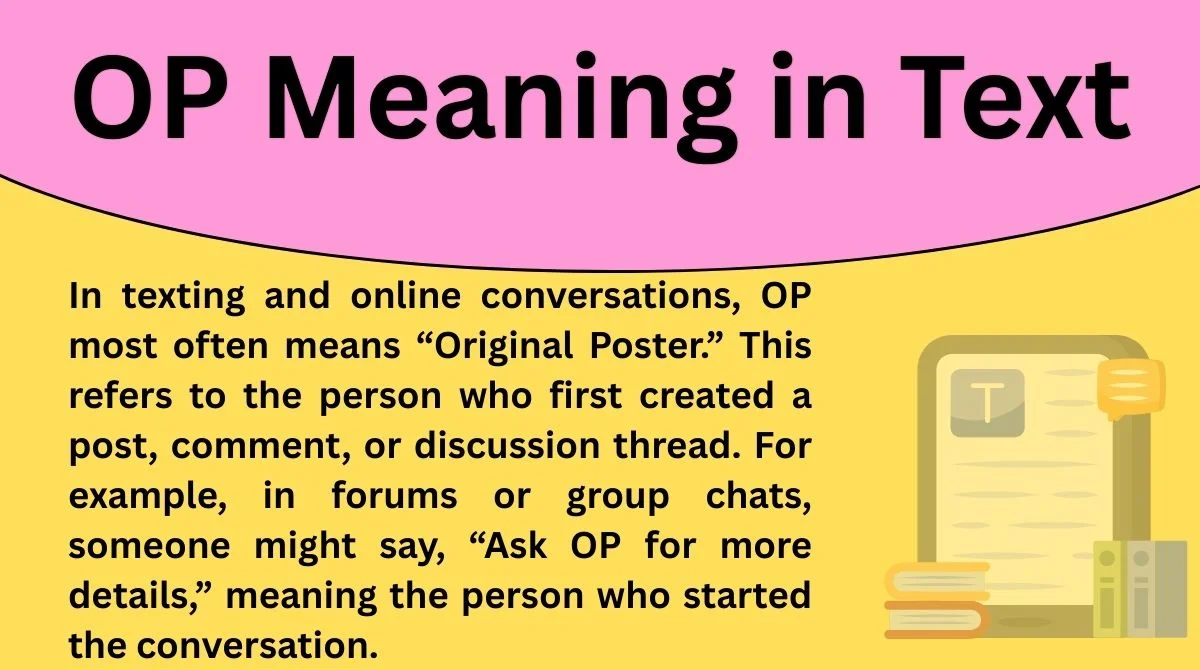
In texting and online conversations, OP most often means “Original Poster.” This refers to the person who first created a post, comment, or discussion thread. For example, in forums or group chats, someone might say, “Ask OP for more details,” meaning the person who started the conversation.
Another common meaning of OP is “Overpowered.” This is used when something or someone is extremely strong, impressive, or better than expected. It’s popular in gaming but has spread into everyday slang. For example, if someone says, “That phone camera is OP,” they mean it’s very good.
The meaning depends on context:
- Conversation about posts → Original Poster
- Talking about skills or performance → Overpowered
Because OP is short and easy to type, it has become widely used in casual chats, comments, and memes. People like abbreviations that save time while still being clear.
Quick examples:
- “OP already answered that question.”
- “Your editing skills are OP 🔥”
- “Who is OP in this story?”
Understanding the context is the key to knowing which meaning is intended.
Full Form, Stands For & Short Meaning of OP
The abbreviation OP has two main full forms:
- Original Poster – the person who created the first post or message.
- Overpowered – something extremely strong, impressive, or dominant.
Both meanings are correct, but they are used in different situations. Over time, people have also created informal variations based on these meanings.
For example:
- “OP move” → a very smart or powerful action
- “OP player” → someone highly skilled
- “OP asked this earlier” → referring to the original poster
Why do people prefer OP instead of full words? Because online communication is fast. Short forms reduce typing and make conversations feel casual.
Other possible meanings exist in specialized contexts, such as:
- Opening (in music or anime discussions)
- Operation (in technical or military language)
- Opinion (rare slang usage)
However, in everyday texting, Original Poster and Overpowered are by far the most common meanings.
Origin, History & First Known Use of OP
The term OP started gaining popularity in early internet forums during the late 1990s and early 2000s. Message boards needed a simple way to refer to the person who created a thread. Instead of typing “the person who posted this,” users began writing OP.
At the same time, gaming communities adopted OP to mean Overpowered. Players used it to describe characters, weapons, or abilities that felt unfairly strong. As gaming culture spread, this meaning entered mainstream internet language.
Social media then accelerated its use. Memes, short comments, and viral content made abbreviations more common. OP became part of everyday digital vocabulary, especially among younger users.
Key timeline:
- Forums era → OP = Original Poster
- Gaming communities → OP = Overpowered
- Social media boom → OP enters mainstream slang
Today, both meanings exist side by side, and most internet users recognize them instantly.
How People Use OP in Daily Conversations
People use OP in many ways beyond forums and gaming. It appears in texting, casual speech, and even jokes. The meaning often depends on the topic being discussed.
Common uses include:
- Complimenting someone’s skill
- Referring to the person who started a conversation
- Describing something impressive
- Reacting to surprising results
Examples:
- “Your cooking is OP 😄”
- “OP didn’t explain the full story.”
- “That trick was OP!”
- “This new update feels OP.”
Sometimes OP is used humorously. Friends might exaggerate by calling something OP even when it’s normal. For example, “You finished the homework in 10 minutes? OP brain.”
Because OP is flexible, it fits many situations. The tone can be serious, playful, or sarcastic depending on context.
OP Meaning Across WhatsApp, Instagram, TikTok & Snapchat
On different platforms, OP keeps similar meanings but is used slightly differently.
Messaging apps (private chats):
- Usually means “overpowered” as a compliment.
- Example: “Your new bike is OP 🚴♂️”
Comment sections:
- Often means “original poster.”
- Example: “OP should share the recipe.”
Short videos and captions:
- Used to describe impressive skills.
- Example: “That transition was OP 🔥”
Story replies:
- Casual praise or reaction.
- Example: “OP editing bro!”
Because these platforms encourage short messages, abbreviations like OP are very common. The meaning is usually obvious from the conversation topic.
Different Meanings of OP in Other Fields
Outside texting, OP can have several professional or niche meanings.
Some examples include:
- Gaming: Overpowered (very strong character or item)
- Music/Anime: Opening theme (intro song)
- Medical: Operation (surgical procedure)
- Business: Operating procedure
- Military: Operation or mission name
Context always determines the meaning. For example, in a hospital conversation, OP will likely mean operation, not original poster.
This shows how abbreviations evolve. A single short term can exist in multiple industries without confusion because people rely on context clues.
Common Confusions, Mistakes & Wrong Interpretations
Many people misunderstand OP because it has more than one meaning. The biggest confusion is mixing Original Poster with Overpowered.
Common mistakes include:
- Thinking OP always means gaming-related
- Assuming OP refers to “operator”
- Misreading OP as “opinion”
Another confusion happens when someone joins a conversation late and doesn’t know who OP is. In that case, OP simply means the person who started the discussion.
Tips to avoid confusion:
- Look at the topic of conversation
- Check if people are discussing a person or performance
- Notice tone (compliment vs reference)
If unsure, you can always ask: “Do you mean original poster or overpowered?”
Similar Terms, Alternatives & Related Slang
There are many slang terms similar to OP, depending on meaning.
If OP means overpowered, related slang includes:
- GOAT (Greatest of All Time)
- untamed
- Fire 🔥
- Beast
- Cracked (gaming slang)
If OP means original poster, alternatives include:
- Thread creator
- Author
- Poster
- Owner of the post
Using these alternatives can make conversations clearer, especially with people unfamiliar with internet slang.
Examples of OP in Real Chat Situations
Here are realistic examples of how OP appears in conversations:
- “OP already answered your question.”
- “That goal was OP ⚽🔥”
- “Bro your aim is OP.”
- “Ask OP for the link.”
- “This hack is OP 😂”
Short chat scenarios:
- Friend: “I finished the game in one day.”
You: “OP skills 😎” - Comment: “How did you cook this?”
Reply: “OP shared the recipe above.”
These examples show both main meanings clearly.
How to Reply When Someone Says OP
Your reply depends on how OP is used.
If OP means compliment (overpowered):
- “Haha thanks!”
- “Appreciate it 🙌”
- “You’re too kind.”
If OP means original poster:
- Answer the question directly
- Provide more details
- Clarify your post
Examples:
- “Thanks! I practiced a lot.”
- “Yes, I’m OP. Here’s the info.”
- “Glad you liked it 😊”
A simple positive response usually works best.
Is OP Still Popular? Trends & Online Usage
Yes, OP is still widely used in 2025–2026. It remains common because:
- It’s short and easy to type
- Works across many topics
- Recognized globally
- Popular in gaming and social media culture
While new slang appears constantly, OP has stayed relevant for years. That stability is rare in internet language.
Trends show that OP is especially popular among:
- Gamers
- Teenagers and young adults
- Social media creators
- Online communities and forums
It may evolve in meaning over time, but it’s unlikely to disappear soon.
FAQs
1. What does OP mean in texting?
It usually means Original Poster or Overpowered, depending on context.
2. What does OP mean in gaming?
In gaming, OP almost always means Overpowered.
3. Is OP a compliment?
Yes, when it means overpowered, it’s a positive compliment.
4. What does OP mean on social media comments?
It often refers to the person who created the post (Original Poster).
5. Can OP have negative meaning?
Sometimes, if something is unfairly strong, people may complain it’s OP.
Conclusion
The OP meaning in text is simple once you understand context.
It usually stands for Original Poster or Overpowered, and both meanings are widely used across chats, comments, and social media.
The abbreviation started in early internet forums and gaming communities but has grown into everyday slang.
Today, people use OP to refer to someone who created a post or to praise something impressive.
Because it’s short, flexible, and easy to understand, OP continues to stay popular online.
If someone calls you OP, it’s often a compliment—so enjoy it.
And if you see OP in a discussion, you now know exactly what it means and how to respond confidently.

Freya Martin is a creative writer who loves playful wordplay, light humor, and engaging content for a global audience.