If you’ve seen “IDM” in a message and wondered what it means, you’re not alone.
Online slang changes fast, and short forms like this can feel confusing at first.
People search for “IDM meaning in text” because they want to understand conversations quickly without asking and feeling awkward.
The good news is that IDM is simple once you know the context.
It’s commonly used in chats, social media, and casual texting to express opinions politely or show uncertainty.
In this guide, you’ll learn the meaning, origin, usage, and examples of IDM in real conversations.
We’ll also explore how it appears across platforms and what to reply when someone sends it. By the end, you’ll feel confident using IDM naturally in your own messages.
What Does IDM Mean in Text & Chat?
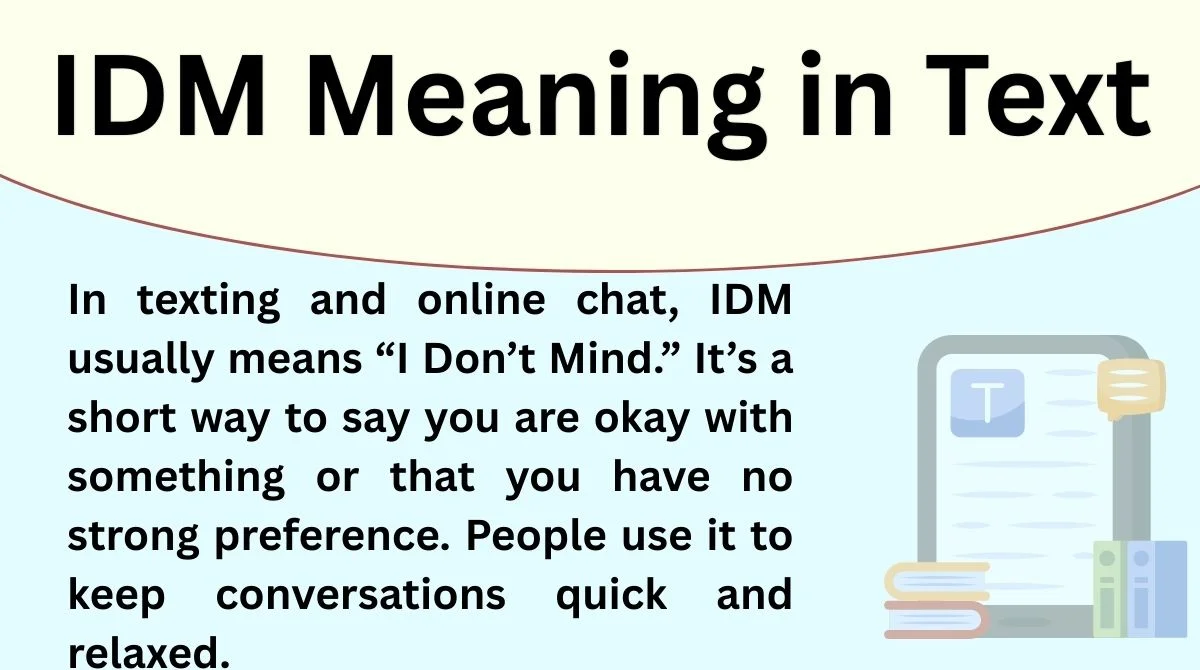
In texting and online chat, IDM usually means “I Don’t Mind.” It’s a short way to say you are okay with something or that you have no strong preference. People use it to keep conversations quick and relaxed.
For example:
- “We can watch a movie or go out.”
“IDM 🙂” - “Is it okay if we meet later?”
“IDM, that works.”
The tone of IDM is friendly and neutral. It often shows flexibility rather than excitement. Someone using IDM is saying, “I’m fine either way.”
Sometimes, IDM can also mean:
- “It Doesn’t Matter” (less common)
- “I Don’t Mean” (rare, usually context-based)
The exact meaning depends on the conversation. In most cases, though, you can safely assume it means “I don’t mind.”
People like using IDM because:
- It saves time typing
- It sounds casual
- It avoids long explanations
- It keeps conversations smooth
Understanding context is key. If someone asks for your opinion and you reply with IDM, it signals you’re easygoing and open to suggestions.
Full Form, Stands For & Short Meaning of IDM
The most accepted full form of IDM in texting is:
IDM = I Don’t Mind
This phrase communicates agreement without strong emotion. It’s softer than saying “yes” and more relaxed than saying “whatever.”
Short meaning:
- Okay with it
- No problem
- Either option works
- I’m fine with that
Here’s how it compares with similar phrases:
- Yes → Clear agreement
- Sure → Positive agreement
- IDM → Neutral agreement with flexibility
People often use IDM when:
- They don’t have a preference
- They want to be polite
- They trust the other person’s choice
- They want to avoid conflict
For example:
- “Should we order pizza?”
“IDM.” - “Do you want to sit inside or outside?”
“IDM, you choose.”
It’s also useful in group chats where decisions are being made quickly. Instead of typing a full sentence, IDM keeps communication short and easy.
Origin, History & First Known Use of IDM
Like many internet abbreviations, IDM grew from the early days of texting and online messaging. When SMS messages had character limits, people started shortening phrases to save time and space. “I don’t mind” naturally became IDM.
It became more common with:
- Instant messaging apps
- Online gaming chats
- Social media conversations
- Mobile texting culture
There is no single known inventor of IDM. Instead, it developed organically as part of digital communication trends, similar to abbreviations like:
- LOL (Laugh Out Loud)
- BRB (Be Right Back)
- IMO (In My Opinion)
Over time, younger users adopted it into everyday conversations. Today, IDM is widely understood in casual chats, especially among teenagers and young adults.
Interestingly, IDM also exists outside texting (like music genres and business terms), but the chat meaning remains the most popular in everyday communication.
How People Use IDM in Daily Conversations
IDM appears in many daily situations because it helps avoid unnecessary discussion. It shows cooperation and openness.
Common situations:
- Making plans
- Choosing food
- Scheduling meetings
- Deciding activities
- Responding to suggestions
Examples:
- “Want to call later?”
“IDM 👍” - “Should we start now or wait?”
“IDM.” - “Is it okay if I bring a friend?”
“IDM at all!”
Why people like using IDM:
- It sounds polite
- It avoids arguments
- It shows flexibility
- It keeps chats short
However, tone matters. Sometimes IDM can sound uninterested if overused. For example, replying “IDM” to everything might make you seem disengaged.
Tip: Add small words or emojis for warmth:
- “IDM 😊”
- “IDM, sounds good”
- “IDM honestly”
This keeps conversations friendly and natural.
IDM Meaning Across WhatsApp, Instagram, TikTok & Snapchat
Across social platforms, IDM keeps the same core meaning: I Don’t Mind. The difference is how often and where it appears.
On WhatsApp:
- Used in personal chats and group planning
- Common among friends and family
On Instagram:
- Seen in DMs and comment replies
- Often casual responses to suggestions
On TikTok:
- Appears in comments
- Sometimes used humorously
On Snapchat:
- Used in quick chats
- Often combined with emojis
Examples:
- “We should try this trend.”
“IDM 😂” - “Call me later?”
“IDM 👍”
The meaning stays consistent, but the tone depends on context and relationship between users.
Different Meanings of IDM in Other Fields
While IDM usually means “I Don’t Mind” in text, it can mean other things in different industries.
Other meanings include:
- Intelligent Dance Music (music genre)
- Identity Management (IT and cybersecurity)
- Integrated Device Manufacturer (technology business)
- Information Data Management (corporate term)
These meanings are mostly used in professional or technical contexts. In casual chats, people almost always mean “I Don’t Mind.”
So if you see IDM in a message from a friend, you can safely assume it’s the texting meaning unless the topic is technical.
Common Confusions, Mistakes & Wrong Interpretations
People sometimes misunderstand IDM because it’s short and context-based.
Common mistakes:
- Thinking it means “I Don’t Know”
- Confusing it with “IDK”
- Assuming it means “Ignore Direct Message”
- Reading it as sarcasm
Key difference:
- IDK = I Don’t Know
- IDM = I Don’t Mind
Tone confusion can also happen. For example:
- “Do you want to come?”
“IDM.”
This could sound neutral or slightly uninterested depending on the situation. Adding extra words helps clarity:
- “IDM, I’d like that”
- “IDM, up to you”
Similar Terms, Alternatives & Related Slang
If you don’t want to use IDM, there are many alternatives.
Similar expressions:
- Up to you
- I’m okay with it
- Doesn’t matter to me
- Either works
- Sure
- No problem
- I’m fine with that
Slang alternatives:
- “I’m cool with it”
- “Whatever works”
- “All good”
Internal linking suggestions:
- IDK meaning in text
- IMO meaning in chat
- TBH meaning online
- NVM meaning in messages
These related abbreviations help readers understand digital communication better.
Examples of IDM in Real Chat Situations
Here are realistic chat examples:
- “Pizza or burgers?”
“IDM 🍕” - “Can we reschedule?”
“IDM, no rush.” - “Movie tonight?”
“IDM 🙂” - “Should I pick you up?”
“IDM, thanks!” - “Is 7 PM okay?”
“IDM 👍”
Quick patterns:
- IDM + emoji = friendly tone
- IDM + extra words = more polite
- IDM alone = neutral response
How to Reply When Someone Says IDM
If someone says IDM, they are giving you the choice. You can respond confidently.
Good replies:
- “Okay, let’s do this then.”
- “Great, I’ll decide.”
- “Thanks, I’ll pick something.”
- “Cool, see you later!”
Friendly responses:
- “Alright 😊”
- “Sounds good!”
- “Perfect!”
The key is to move the conversation forward since they left the decision to you.
Is IDM Still Popular? Trends & Online Usage
Yes, IDM is still used, but not as commonly as some other abbreviations like LOL or IDK. It remains popular in casual texting, especially among younger users.
Trends show:
- More emojis replacing words
- Short replies becoming common
- Casual tone dominating chats
Even so, IDM survives because it fills a useful role — polite agreement without commitment.
It’s unlikely to disappear anytime soon because:
- It’s simple
- It’s practical
- It’s widely understood
FAQs
1. What does IDM mean in texting?
It means “I Don’t Mind,” showing you’re okay with something.
2. Is IDM rude?
No. It’s neutral. Adding emojis makes it friendlier.
3. What’s the difference between IDM and IDK?
IDM = I Don’t Mind
IDK = I Don’t Know
4. Can IDM mean something else?
Yes, in technical fields, but in chat it almost always means “I Don’t Mind.”
5. When should I use IDM?
Use it when you have no strong preference or want to be flexible.
6. Is IDM formal or informal?
It’s informal and best for casual conversations.
Conclusion
Understanding the IDM meaning in text is simple once you know the context.
Most of the time, it stands for “I Don’t Mind,” a polite and relaxed way to show flexibility in conversations.
People use it when making plans, answering questions, or letting others decide.
While IDM also has technical meanings in other fields, its chat usage remains the most common.
Adding small words or emojis can make it sound warmer and more personal.
As digital communication continues to evolve, abbreviations like IDM remain useful because they save time and keep conversations smooth.
Now that you know how to use it, you can reply confidently the next time you see IDM in a message.

Freya Martin is a creative writer who loves playful wordplay, light humor, and engaging content for a global audience.