If you spend time texting, gaming, or scrolling through social media, you’ve probably seen someone type AFK and disappear mid-conversation.
Naturally, many people search for afk meaning in text because the abbreviation pops up everywhere—from casual chats to fast-paced online games.
AFK is short, simple, and incredibly common, yet it can still confuse people who are new to internet slang or digital conversations.
Understanding what AFK means helps you follow chats better, respond appropriately, and avoid awkward misunderstandings.
It’s especially useful when messaging across platforms like WhatsApp, Instagram, or TikTok, where short replies rule.
In this guide, we’ll break down the meaning of AFK in plain English, explore where it came from, and show how people actually use it today—complete with real chat examples and tips on how to reply naturally.
What Does AFK Mean in Text & Chat?
AFK is an abbreviation used in text messages and online chats to let others know that someone is temporarily unavailable. When a person says AFK, they’re signaling that they won’t be able to respond right away. It’s a polite and efficient way to manage expectations in fast-moving conversations.
In most cases, AFK doesn’t mean the person has completely left the conversation forever. Instead, it suggests a short break—maybe they’re grabbing food, answering a call, or stepping away from their phone or computer for a few minutes. This is why AFK is often followed by a reason or a time estimate, though that’s optional.
AFK is especially common in environments where real-time interaction matters, such as group chats, online games, work chats, or live streams. By saying AFK, users avoid seeming rude or unresponsive. It acts as a digital “be right back.”
Importantly, AFK is informal. You wouldn’t normally use it in professional emails, but it fits perfectly in casual or semi-casual settings. Its meaning stays consistent across most platforms, making it one of the easiest slang terms to understand once you know it.
Full Form, Stands For & Short Meaning of AFK
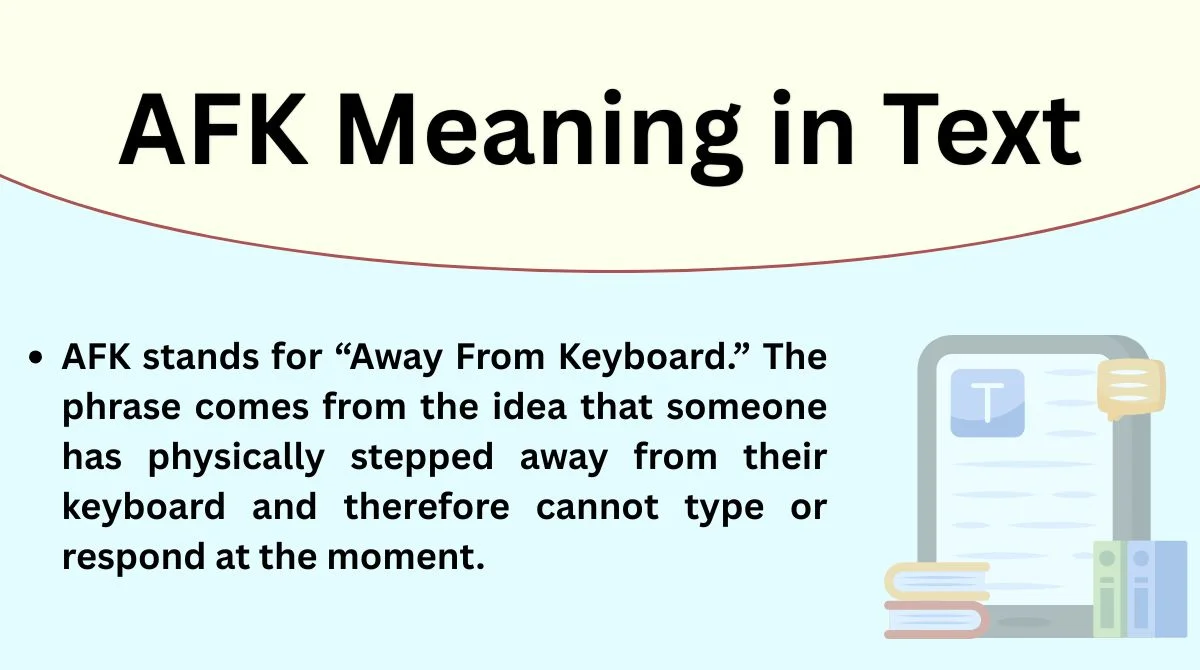
AFK stands for “Away From Keyboard.” The phrase comes from the idea that someone has physically stepped away from their keyboard and therefore cannot type or respond at the moment.
Over time, the meaning has expanded beyond literal keyboards. Today, AFK applies just as easily to phones and tablets. Even if someone is holding their phone, saying AFK still means they’re not actively available to chat.
Short meaning of AFK:
👉 I’m temporarily unavailable.
Here’s how people usually understand it in context:
- A short break, not a long absence
- No urgent response expected
- The person may return soon
Because it’s an abbreviation, AFK is often written in lowercase (afk), uppercase (AFK), or mixed case without changing its meaning. It’s also sometimes paired with time indicators like “5 mins AFK” or reasons like “AFK eating.”
The simplicity of AFK is what makes it powerful. In just three letters, it communicates status, intention, and courtesy—all without interrupting the flow of conversation.
Origin, History & First Known Use of AFK
The origin of AFK goes back to the early days of the internet, particularly in online chat rooms and multiplayer games of the 1990s. During that era, users relied heavily on desktop computers, and stepping away from the keyboard literally meant being unable to communicate.
AFK became popular in environments like IRC (Internet Relay Chat), early forums, and PC-based multiplayer games. Players needed a quick way to explain sudden silence without typing long explanations. AFK solved that problem perfectly.
As online gaming grew, AFK became standard gaming vocabulary. Players would announce AFK before leaving their character idle, helping teammates understand why someone wasn’t participating. Over time, the term spread beyond gaming into general internet culture.
With the rise of smartphones, the phrase technically became outdated—people aren’t always tied to keyboards anymore. Still, the term stuck. AFK evolved from a literal description into a symbolic one, representing temporary absence from digital interaction.
Today, AFK is so widely recognized that many users don’t even think about its original meaning. It’s a great example of how internet slang adapts, survives, and becomes part of everyday language.
How People Use AFK in Daily Conversations
In daily conversations, AFK is used to manage availability and keep communication smooth. It’s rarely dramatic or serious—just practical. People drop AFK into chats when life briefly pulls them away from the screen.
Common real-life situations include:
- Someone needs to answer the door
- A quick phone call comes in
- Food arrives
- Work or school interrupts
AFK is often used casually and without punctuation. It can be a standalone message or part of a sentence. The tone is usually neutral or friendly, not formal.
People also use AFK to avoid pressure. By announcing AFK, they remove the expectation of immediate replies. This is especially helpful in group chats where silence might otherwise be noticed.
In voice or video contexts, AFK can also signal stepping away while staying connected. Overall, AFK functions as a digital courtesy—short, efficient, and widely understood.
AFK Meaning Across WhatsApp, Instagram, TikTok & Snapchat
The afk meaning in text stays consistent across platforms, but how it’s used can vary slightly depending on the app’s culture.
On WhatsApp, AFK is common in group chats. People use it to explain delayed replies without leaving the group or muting notifications.
On Instagram, AFK appears mostly in DMs, especially during live conversations or gaming-related chats. It’s less common in comments but still understood.
On TikTok, AFK is often seen in livestream chats. Creators or viewers may say AFK to explain brief inactivity while staying connected to the stream.
On Snapchat, AFK can appear in chat messages, though users might also rely on disappearing messages or simply go silent. When used, it still means a temporary pause.
Across all platforms, AFK keeps its core meaning: not available right now, but not gone for good.
Different Meanings of AFK in Other Fields
While AFK mostly means “Away From Keyboard,” it can have different interpretations depending on context. These alternate meanings are far less common but still worth noting.
In gaming, AFK can describe a player who is inactive but still logged in. This can sometimes carry a negative tone if the inactivity affects gameplay.
In work or productivity tools, AFK may refer to a status indicator showing someone is idle or inactive.
Rarely, AFK may appear as an acronym in technical or organizational contexts, but these uses are niche and usually clarified by context.
For everyday texting and social media, however, AFK almost always means temporary absence. Context is your best guide if you ever feel unsure.
Common Confusions, Mistakes & Wrong Interpretations
One common mistake is assuming AFK means someone is ignoring you. In reality, it’s usually the opposite—it’s a courtesy message explaining silence.
Another confusion is mixing AFK with BRB (Be Right Back). While similar, AFK often implies being away longer or more physically disconnected.
Some people also think AFK means someone has logged out entirely. That’s incorrect. AFK usually means the person is still online, just inactive.
Misreading AFK can lead to unnecessary frustration, especially in fast chats. Understanding its intent helps keep conversations relaxed and respectful.
Similar Terms, Alternatives & Related Slang
AFK belongs to a family of internet shorthand used to describe availability. Similar terms include:
- BRB – Be Right Back
- IDLE – Logged in but inactive
- TTYL – Talk To You Later
- Offline – Not connected at all
Each term has a slightly different nuance, but AFK remains one of the most flexible and widely used options.
Examples of AFK in Real Chat Situations
Quick, natural examples make AFK easy to understand:
- “AFK for dinner 🍽️”
- “Phone ringing, afk”
- “AFK 10 mins, don’t start without me 😅”
- “afk, back soon”
These short messages clearly communicate status without over-explaining.
How to Reply When Someone Says AFK
Replying to AFK is simple and polite. You don’t need to say much.
Common responses include:
- “Okay 👍”
- “No worries”
- “Take your time”
- “Got it, see you soon 😊”
In group chats, you can just continue the conversation or wait, depending on context. AFK doesn’t demand a reply—it just informs.
Is AFK Still Popular? Trends & Online Usage
Yes, AFK is still very popular. Despite newer slang appearing constantly, AFK remains relevant because it solves a basic communication need.
Its longevity comes from clarity and simplicity. New platforms haven’t replaced it; they’ve adopted it. From gaming to social media, AFK continues to bridge real life and digital presence.
As long as people step away from screens—and they always will—AFK will stay useful.
FAQs: What People Also Ask About AFK Meaning in Text
1. Does AFK mean offline?
No. AFK usually means temporarily unavailable, not fully offline.
2. Is AFK rude to say?
Not at all. It’s generally polite and helpful.
3. Can AFK be used at work?
Only in informal work chats, not professional emails.
4. Is AFK only for gaming?
No. It’s now common in all kinds of chats.
5. How long does AFK usually last?
It varies—anywhere from a few minutes to longer breaks.
Conclusion
Understanding the afk meaning in text helps you navigate modern conversations with ease.
AFK is a simple, friendly way to let others know you’re temporarily unavailable without sounding rude or disappearing without explanation.
From its roots in early internet culture to its everyday use on WhatsApp, Instagram, TikTok, and Snapchat, AFK has proven its staying power.
What makes AFK special is its flexibility. It works across platforms, age groups, and situations, all while keeping communication smooth and respectful.
Once you know what it means and how to respond, you’ll spot it everywhere—and probably start using it yourself.
In a world of constant connectivity, AFK gives people permission to step away, even if just for a moment.

Freya Martin is a creative writer who loves playful wordplay, light humor, and engaging content for a global audience.